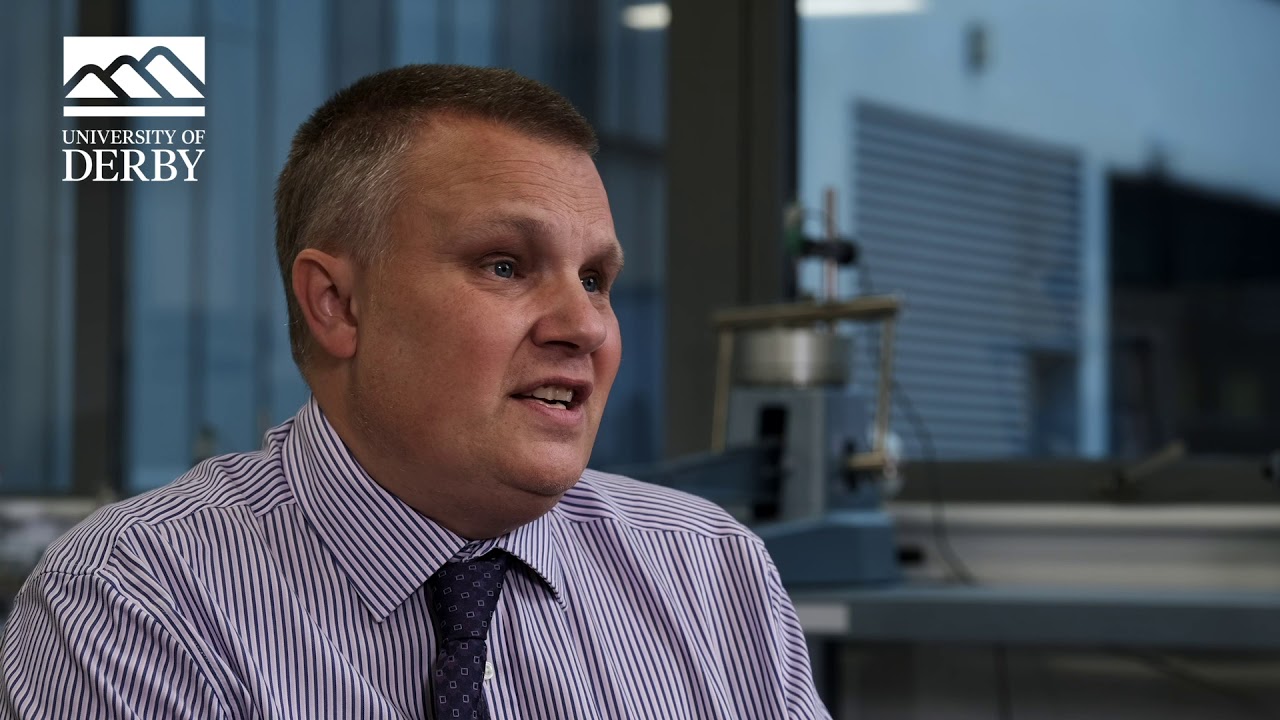
Civil Engineering and Construction - your questions answered
Programme Leader for Civil Engineering, Derek Spalton, answers some of the most frequently asked questions about Civil Engineering and Construction at the University of Derby.
Foundation Year - helping you to achieve more
Including a foundation year as part of your four-year study programme will give you a head start in your academic and professional life. The foundation year offers the chance to strengthen your skills, knowledge and confidence – with extensive support from our expert staff – before you advance to stage one of your honours degree. It could also be beneficial if you are planning a career change and want to get to grips with aspects of subjects which are new to you.
Our degrees with a foundation year are continuous, meaning that you won’t need to apply again once you have successfully completed the first year.
Sought-after skills
The BSc (Hons) Civil Engineering features a compelling mix of lectures, real-life projects and site visits so you can develop all the knowledge and skills that employers are looking for. We will introduce you to key skills relating to structures, fluids, geology, soil mechanics, surveying and materials.
An example of the type of local project you will get to work on is the Down to Earth Derby's 'New Commons'. For the last several years we have been working with Down to Earth Derby, on nature-based regeneration and connecting communities with nature and growing food. A major project we are working on at the moment, with the Eden Project, is a community garden on part of Sturgess Fields, a site owned by the University between Kedleston Road and Markeaton Street sites. The plan is to create a New Commons that will be managed with the community. There are opportunities for you to work on this project, designing sustainable buildings and structures.
Going on placement and into graduate roles: Civil Engineering student stories
Joe, Cally and Jacob are three Civil Engineering students that secured placements at Dorset Council, Graham, and Via East Midlands. Here they share their experience of going from practical classes to industry placements - discover why they chose the course, how classroom learning connects to real-world problems, and what's next for them.
Strong professional credentials
Once you have completed your Foundation Year, you will study our BSc (Hons) Civil Engineering degree which is accredited as fully satisfying the educational base for you to gain Incorporated Engineer (IEng) status. Following a period of relevant experience and a professional review, it leads to membership of the Institution of Civil Engineers (MICE), the Institution of Structural Engineers (MIStructE), the Chartered Institution of Highways and Transportation (MCIHT), and the Institute of Highway Engineers (MIHE). Find out more from the Joint Board of Moderators.
Please note that our modules are subject to change - we review the content of our courses regularly, making changes where necessary to improve your experience and graduate prospects.
You will learn through a mixture of lectures, seminars, tutorials, on and off campus laboratory and site work, plus visits to companies.
How you are assessed
You will be assessed through workshop laboratories, surveying field work, group work and individual assignments. Some traditional exams may be involved for design tests.
As a BSc (Hons) Civil Engineering graduate, you will have not only the knowledge and skills to embark on your career but also the academic base for Incorporated Engineer status.
An Incorporated Civil Engineer is a person with an accredited bachelor degree and professional experience who can maintain and manage applications of current and developing technology, and undertake engineering design, development, manufacture, construction and operation. The qualification is essential to become a practising engineer and to lead a team in a professional organisation.
You can also choose to continue your professional development and further study in the discipline of civil engineering by taking our MSc Civil Engineering and Construction Management.
may apply to students who meet certain criteria.
These are the typical qualification requirements for September 2026 entry.
| Requirement | What we're looking for | | UCAS points | 72 |
| A Level | DDD |
| T Level | Pass |
| BTEC | MMP |
| GCSE | GCSE Maths and English Grade 4/Grade C (or above) or equivalent qualification |
| Access to HE | Pass Access to HE Diploma with 60 credits: 45 at Level 3 with a minimum of Distinction: 0, Merit: 30, Pass: 15 |
| English language requirements | IELTS: 6.0 (with at least 5.5 in each skills area) |
These are the typical qualification requirements for September 2027 entry.
| Requirement | What we're looking for | | UCAS points | 72 |
| A Level | DDD |
| T Level | Pass |
| BTEC | MMP |
| GCSE | GCSE Maths and English Grade 4/Grade C (or above) or equivalent qualification |
| Access to HE | Pass Access to HE Diploma with 60 credits: 45 at Level 3 with a minimum of Distinction: 0, Merit: 30, Pass: 15 |
| English language requirements | IELTS: 6.0 (with at least 5.5 in each skills area) |
| 2026/27 | Full-time | Part-time |
|---|
| UK | £9,535 per year* | N/A |
| International | £15,500 per year* | N/A |
*This is the fee for the Foundation Year. Subsequent UK fees are £9,535 per year. Subsequent International fees are £17,500 per year.
Further information about our fees and support you may be entitled to
Teaching hours
Like most universities, we operate extended teaching hours at the University of Derby, so contact time with your lecturers and tutors could be anytime between 9am and 9pm. Your timetable will usually be available on the website 24 hours after enrolment on to your course.
Course updates
The information provided on this page is correct at the time of publication but course content, costs and other individual course details do change from time to time and are updated as often as possible, so please do check these pages again when making your final decision to apply for a course. Any updated course details will also be confirmed to you at application, enrolment and in your offer letter.
If you are thinking about transferring onto this course (into the second year for example), you should contact the programme leader for the relevant course information as modules may vary from those shown on this page.