Study our brand-new curriculum, which has been updated to keep pace with the industry and develop skills which you can utilise in the world of journalism and communications.
Build your experience by working in the sport you’re most passionate about while you’re studying. We’ll use our extensive contacts to help you get your foot in the door at sports clubs and media organisations, and we’ll provide access to international, national and domestic sporting events.
Learn from tutors that are experienced and well connected, having worked for organisations such as the BBC, ITV, the Premier League, The Guardian and The Times.
Top15for satisfaction with teachingJournalism - The Guardian University Guide 2026
Top20for careers after 15 monthsJournalism - The Guardian University Guide 2026
Top20for journalism in the UKJournalism - The Guardian University Guide 2026
This course let me combine my love of sport and my passion for storytelling. The staff were incredibly supportive and always encouraged me to push beyond what I thought I was capable of. I started the course thinking that I was only a writer, but I’ve discovered so much more. That growth has shaped both my confidence and the start of my career.
Kirsty Lewis
Graduate and Communications Officer at Paddle UK
Students formed part of the media team at the 2023 European Para Table Tennis Championships
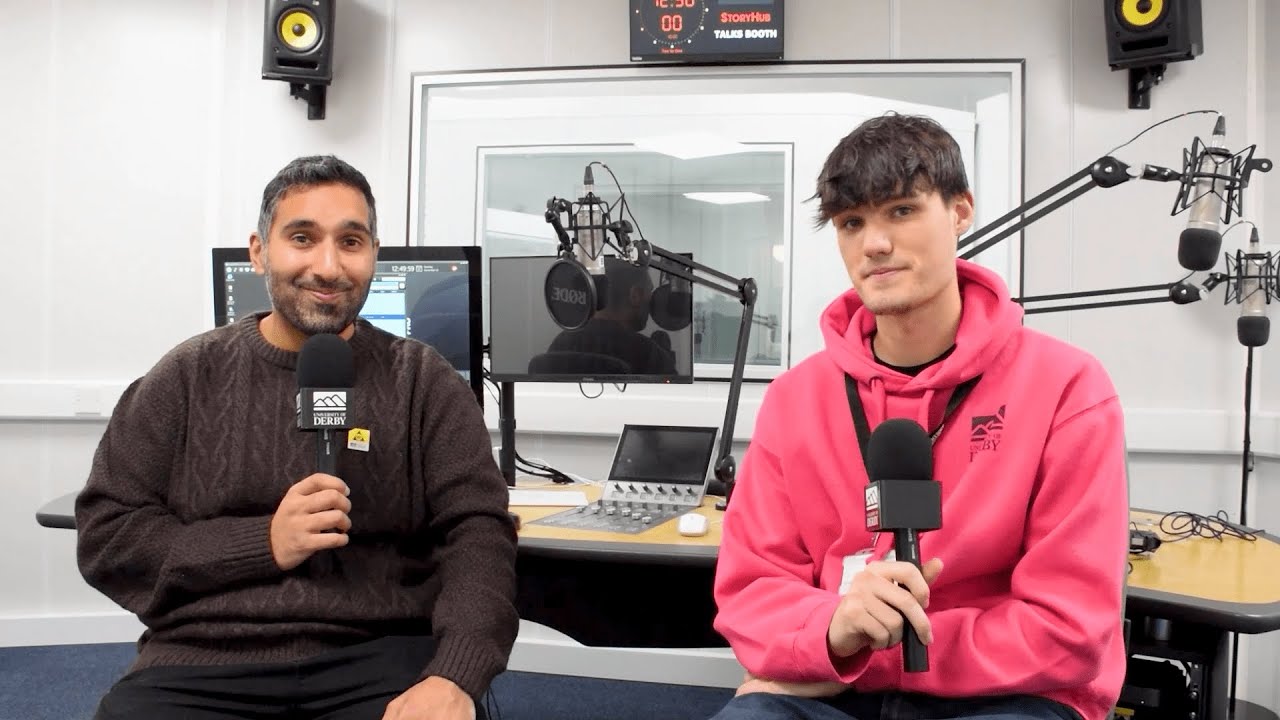
Explore Journalism courses at Derby with alumnus Baasit Siddiqui
Join TV personality, Educator and Alumnus Baasit Siddiqui for an in-depth look at the Journalism courses we offer. Baasit is joined by Professor Katharine Cox, Head of School of Humanities and Journalism and Interim Head of School of Arts, to gain an insight into the choice of courses and joint honours options available. Baasit also catches up with Max, BA (Hons) Football Journalism student, to hear about the real-world experience and transferable skills Max has already gained on the course.
Explore a range of videos showcasing our Journalism degrees on this YouTube playlist.
We’ve made changes to our curriculum to ensure that we’re fit for the industry as it is. New modules on e-sports, videography, commentary and punditry, data analysis and visualisation, and the societal impact of journalism complement those delivered with focus on more established aspects of the profession.
This is in response to changes in the industry, such as the proliferation of specialist sport websites and the shift in power away from traditional media. Sports clubs and organisations are now taking control of their own narrative and looking for well-qualified media professionals who can help them build their audiences and communicate directly with fans. Our aim is to help you build those skills alongside the essential aspects of traditional journalism, such as interviewing, newswriting and media law.
Throughout your studies, you will gain significant hands-on experience of news gathering, reporting, and producing content for your chosen sport — including sports reports, social media content, stories and profiles of athletes, podcasts, feature articles, and blogs. You’ll cover all aspects of the news cycle from previewing events to live reporting and post-event analysis. To see what our students get up to and view the content they produce, take a look at our StoryHub website and X feed.
As well as producing content, you’ll also be asked to analyse the work of current journalists to understand what best practice looks like. You will also learn more generally about communication, media, and societal issues in journalism.
StoryHub
The best news, sport and alternative stories told by students of Journalism at the University of Derby.
Our tutors are well-connected in the industry. They will put you in touch with sports and media organisations, so you can start to gain valuable work experience while you are studying.
You will not only have the opportunity to make the most of attending major international, national and domestic events, but also take advantage of our strong links with numerous clubs and organisations across a variety of sports. Our current group of students regularly work in basketball, netball, tennis, cricket, cycling, horse racing and motorsport, turning our contacts into their own, and setting themselves up for a successful future in the industry.
By the end of the course – provided you’ve made the most of these opportunities – you should have an impressive editorial portfolio to show prospective employers.
Follow your passion
Unlike other sports journalism courses, you have the option to specialise in a sport of your choice — from the more obvious ones like cricket, rugby and football, to minority sports. You are expected to gain an in-depth knowledge of your sport, covering every level — from grassroots to the biggest names in international sport. You will learn about the business, finance and use of data in sport, and critically explore other current issues.
This specialist sports journalism degree is also extremely varied, with optional modules in years two and three, so you can tailor your degree to your own talents and interests.
Capturing the spirit of Shrovetide Football
Read how our Journalism students navigated challenging terrain, gained valuable experience and became published journalists while covering one of Derbyshire's proudest traditions.
Fresh from hosting ITV’s coverage of the Rugby World Cup, broadcaster Mark Pougatch visited us to give students the benefits of his advice and experience
Explore our specialist facilities
Gain practical, hands-on experience in our real world learning facilities. You will develop new skills and knowledge in your subject, supported by our expert teaching team.
► Film and TV studios
Our Markeaton Street site has a dedicated film and television studio space for teaching and student projects - supported by experienced technicians.
► Radio studios
Our radio studios have recently been refurbished and fitted with Calrec technology - a leading range of broadcast audio mixing consoles and equipment. All large media companies are now migrating to this technology, so we're ahead of the game.
Boost your employability with a placement year
Take an optional placement year to put your skills into practice in a real-world setting. We’ll support you in finding a placement and throughout your time in industry. It’s a great way to gain valuable experience for your CV, build contacts, and explore career options before you graduate.
What you will study
The key to becoming a journalist is to learn the essential skills so, at the start of your degree, you will learn the basics of finding and telling stories. As you progress you will develop more advanced skills in multimedia content production.
Please note that our modules are subject to change - we review the content of our courses regularly, making changes where necessary to improve your experience and graduate prospects.
Build, Create, Innovate
Whether it's computing, photography, or engineering, our top-tier facilities — including a new suite of recording studios and a £12 million STEM Centre — provide the perfect setting to excel.
The best way to find out if studying at Derby is right for you is to experience an Open Day. Get a feel for the city and campus, tour our first-class facilities and see where you could be living.
You will learn in a variety of ways – for example through:
Lectures and seminars, including guest lectures from industry experts
Practice-based workshops
Trips to sports events and clubs
News days
Group work
Independent study.
Assessment
Our assessments are focused on teaching you how to be a journalist. There are no exams and you’ll be assessed mainly on the content you produce, which might be blogs, podcasts, videos, features, and news articles. For some modules, you will need to complete more academic assessments, including essays, case study reports and presentations.
Who you'll meet
You will benefit from the experience of all of our staff within the Journalism department, however in the main your course will be delivered by:
Niall Hickman is the Programme Leader for Specialist Sports Journalism. He worked in the industry for three decades, covering a variety of sports including football, cricket, rugby, golf, boxing, athletics and even the World Pooh Stick Championships! He’s worked for media outlets such as the South London Press, ITV, Sky Sports, the Daily Mail and the Daily Express. Niall has also ghost-written two autobiographies for boxing world champions Ricky Hatton and Carl Froch. His career highlights were interviewing the likes of Muhammad Ali, Mike Tyson, Sugar Ray Leonard, Lennox Lewis and German footballing legend Lothar Mattheus.
Carly Baldwin: Lecturer in Sports Journalism
Carly Baldwin is a lecturer and sports journalism graduate herself. Since graduating, she has spent the last 15 years working predominantly in PR and communications roles across the sector, including with football clubs, national governing bodies and at major multi-sport events. Her career highlight was working at the London Olympics 2012.
By the end of this specialist sports journalism degree, you should have plenty of professional experience and contacts to get your career off to a flying start.
The course develops the broad range of knowledge and skills you need to become a sports journalist today, but it also prepares you for broader careers in journalism, PR and marketing, advertising, corporate communications, law and public administration or politics.
Our specialist sports journalism graduates are now working for clubs and organisations like Leicester Tigers Rugby Club, Leicester City FC, Channel 5 Boxing, British Swimming, the LTA (Lawn Tennis Association), England Netball, World Snooker, Bet 365, BBC Radio Derby, Derbyshire County Cricket Club and many more.
Getting you career ready
Your degree is only part of your story.
We're here to help prepare you for life after university.
These are the typical qualification requirements for September 2026 entry.
Requirement
What we're looking for
UCAS points
112
A Level
BBC
T Level
Merit
BTEC
DMM
GCSE
GCSE Maths and English Grade 4/Grade C (or above) or equivalent qualification
Access to HE
Pass Access to HE Diploma with 60 credits: 45 at Level 3 with a minimum of Distinction: 15, Merit: 24, Pass: 6
English language requirements
IELTS: 7.0 (with at least 6.5 in each skills area)
These are the typical qualification requirements for September 2027 entry.
Requirement
What we're looking for
UCAS points
112
A Level
BBC
T Level
Merit
BTEC
DMM
GCSE
GCSE Maths and English Grade 4/Grade C (or above) or equivalent qualification
Access to HE
Pass Access to HE Diploma with 60 credits: 45 at Level 3 with a minimum of Distinction: 15, Merit: 24, Pass: 6
English language requirements
IELTS: 7.0 (with at least 6.5 in each skills area)
Offers will be made initially based on your application, including predicted grades and/or grades you have already achieved. You may be given the opportunity, within your offer letter, to submit a portfolio. If you submit a strong portfolio we will make you an unconditional offer, to reflect the quality of your work and your potential.
If you are in Year 13 and applying for a full-time undergraduate course (including our joint honours courses), we recommend that you apply through UCAS.
Like most universities, we operate extended teaching hours at the University of Derby, so contact time with your lecturers and tutors could be anytime between 9am and 9pm. Your timetable will usually be available on the website 24 hours after enrolment on to your course.
Course updates
The information provided on this page is correct at the time of publication but course content, costs and other individual course details do change from time to time and are updated as often as possible, so please do check these pages again when making your final decision to apply for a course. Any updated course details will also be confirmed to you at application, enrolment and in your offer letter.
If you are thinking about transferring onto this course (into the second year for example), you should contact the programme leader for the relevant course information as modules may vary from those shown on this page.


.jpg)


.jpg)
-(1).jpg)


.jpg)
/prod01/derbyacuk/media/derbyacuk/assets/organisation/services/centre-for-excellence-in-learning-and-teaching/Animation-5098-0131-(1).jpg)
/prod01/derbyacuk/media/derbyacuk/assets/study/support/module-evaluation-questionnaire-promo.jpg)
/prod01/derbyacuk/media/derbyacuk/assets/study/postgraduate/Why-Choose-Derby-PG-Tutor-01---2000-x-1333-1066x1333.jpg)
/prod01/derbyacuk/media/derbyacuk/assets/study/employability/Image---employability.jpg)
.jpg)
-(1).jpg)