This distinctive, diverse and challenging programme integrates critical and cultural theory and will change the way you think about literature, language and life. You will encounter a wide range of literature from across the globe, studied in the context of perspective-altering ideas about identity, desire, cultural politics and the nature of reality itself. You will also have the opportunity to study English Language.
You could not have a better backdrop to your studies than Derbyshire. One of the centres of the British Enlightenment during the eighteenth century, the county has a strong literary heritage and inspired many great writers including Jane Austen, Walter Scott, Charlotte Brontё, George Eliot and Henry James.
- The programme’s distinctive core of engagement with literary, critical and cultural theory will enable you to develop a highly nuanced and sophisticated approach to the analysis of literature, language and culture
- You will explore fascinating aspects of the subject, including the evolution of fantasy, the representation of crime, the legacy of Empire, cultural politics, existentialist writing, classical myth and the 19th-century realist novel. Alongside the literature modules, you can also explore key areas in linguistics, including sociolinguistics, psycholinguistics and the relationship between language and identity
- This degree will change the way that you think: you will encounter a wide range of literature from across the globe, studied in the context of perspective-altering theories concerning identity, desire, cultural politics and the nature of reality itself
- Tailor this course to suit you, choose from a wide range of thought-provoking options in stages two and three so that you can focus on your own literary and language interests
- The course equips you with the skills and knowledge you need for excellent career prospects in fields which include (though are not limited to) teaching, journalism, publishing and arts administration
- Our teaching team is made up of experts who are passionate about the subject and dedicated to your success
- There is the opportunity to broaden your experience with work-based learning projects, study visits to cultural and heritage institutions, as well as lectures and seminars delivered by guest speakers
- Our assessment strategy is designed to produce confident, articulate and independent graduates. There are no exams. As well as essays, you will be assessed on your participation in seminars and your ability to lead them. We also place great emphasis on developing your research skills, with conference papers and independent projects forming a key part of the second and third year
- You can choose to study for a semester in one of our American partner universities
- Eastern Michigan University
- Keene State College in New Hampshire
- Longwood University in Virginia
- Indiana University - Purdue University Indianapolis
A broad perspective
You will be introduced to a range of cultural expression from across the globe and from diverse historical periods, broadening your understanding of the variety of human experience and the different literary modes which capture this.
The course covers literatures from the ancient past to the present day; from Africa and the Caribbean, America and continental Europe as well as from Britain and Ireland. It includes detailed surveys of early modern literature, the Enlightenment, the nineteenth-century realist novel and the modernist experiments of the early twentieth century.
Inspirational teaching
You will be taught by an enthusiastic team with research expertise covering a broad range of literary interests.
You will also benefit from guest seminars and lectures, including those given by our Visiting Professor, Catherine Belsey, an internationally-recognised scholar whose work has profoundly influenced the way English is studied and taught.
Tailored to suit you
The flexibility of the English degree means you can choose from a wide range of thought-provoking options in stages two and three so that you can focus on your own literary interests.
The ideal setting
You could not have a better backdrop to your studies than Derbyshire. One of the centres of the British Enlightenment during the eighteenth century, the county has a strong literary heritage and inspired many great writers including Jane Austen, Walter Scott, Charlotte Brontё, George Eliot and Henry James.
A career focused degree
An English degree will open up a range of career options. However, we also recognise the importance of supporting you to develop the skills sought by employers to maximise your employability.
You will have personal development planning (PDP) interviews with your Year Tutor throughout your degree. Your tutor will help you explore career aspirations, review your PDP file and advise you on developing transferable skills.
We offer the opportunity for applied study through our work-based learning modules, which can be taken as options and where you can undertake projects and placements at cultural institutions There is also a programme of employability workshops and talks.
Not just lectures and classrooms
You will take part in trips and study visits to cinemas, film festivals, theatres, museums, galleries and heritage centres where you can observe, broaden your cultural knowledge and also apply what you are learning in practice.
We also work closely with the Derby-based 1623 Theatre Company so you have the opportunity to try your hand at directing play scenes, and with Writing East Midlands so you can contribute to writing-related events,Our innovative conference module, Literature in Society, enables you to collaboratively produce and market a paper to be delivered to an invited audience at a public conference.
Study in America
You can choose to spend part of your degree studying at one of our partner universities in America:
- Eastern Michigan University
- Keene State College in New Hampshire
- Longwood University in Virginia
- Indiana University - Purdue University Indianapolis
English - your questions answered
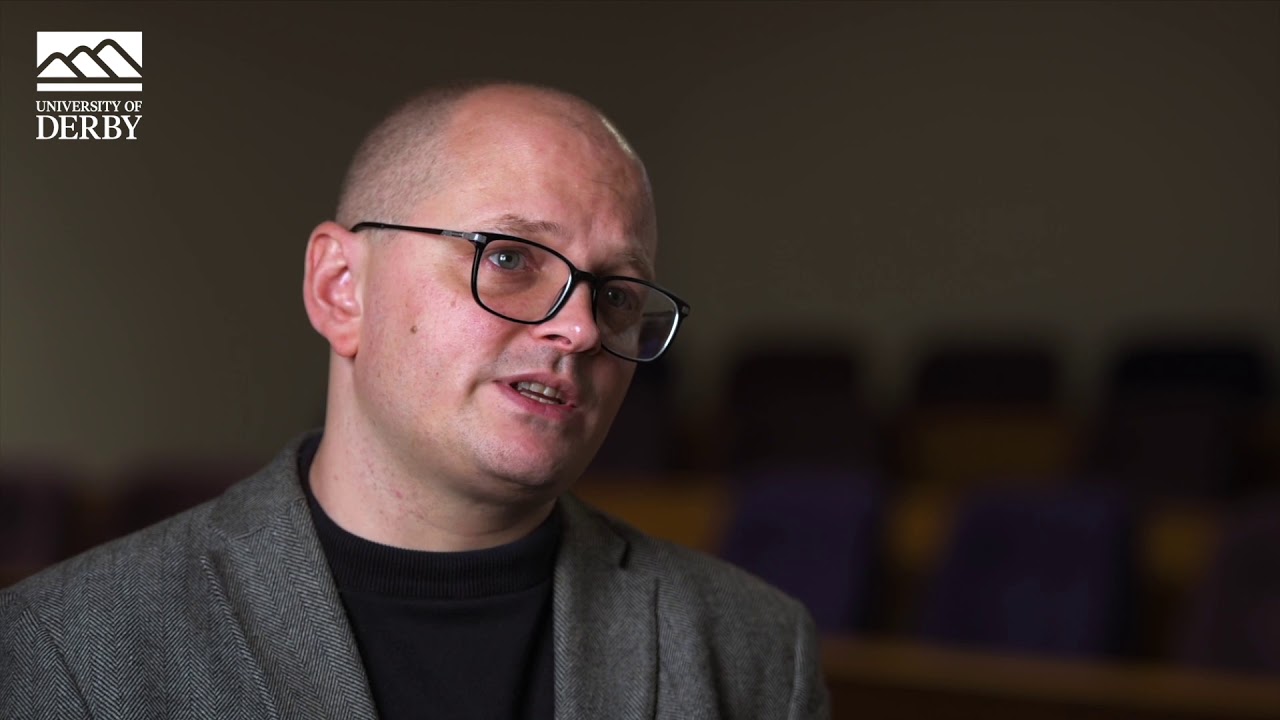
In the below video, Senior Lecturer, Dr Paul Whickman, answers some of the most frequently asked questions about English at the University of Derby.
Boost your employability with a placement year
Take an optional placement year to put your skills into practice in a real-world setting. We’ll support you in finding a placement and throughout your time in industry. It’s a great way to gain valuable experience for your CV, build contacts, and explore career options before you graduate.
Please note that our modules are subject to change - we review the content of our courses regularly, making changes where necessary to improve your experience and graduate prospects.
Assessment
During your foundation year you will be assessed mainly by coursework, and with some in-class tests.
For the rest of your degree the assessment strategy is designed to produce confident, articulate graduates with a broad set of skills. There are no exams and forms of assessment include seminar debates, group presentations and conference papers alongside essays and longer research projects. We place great emphasis on developing your research skills, with independent projects playing a key part in stages two and three.
Who you will meet
You will be taught by our team of engaging, passionate and inspiring subject experts.
Dr Alice Haines is a Lecturer in English Language with expertise in literary linguistics, including stylistics, cognitive poetics, narratology and pragmatics. Her research focuses on how readers recognise and appreciate humour in fiction and poetry.
Dr Cara Penry Williams is a Senior Lecturer in English Language. She completed her PhD in Linguistics at the University of Melbourne. Her specialisms include language and identity, global Englishes, research methods, discourse analysis and sociolinguistics. She has published on folklinguistics and social meaning, Australian English, pragmatic markers, intercultural communication and other topics related to her various research projects.
Dr Robin Sims is the Programme Leader for BA (Hons) English. He studied English and American Literature at the University of East Anglia before completing a Masters and PhD at Cardiff University’s Centre for Critical and Cultural Theory. His specialisms include literary theory, modernism and postmodernism, and he has published on psychoanalytic approaches to literature and on the construction of the Green Man in twentieth-century culture.
Professor Samuel Kasule is a Professor of Post-colonial Theatre and Performance. He studied Drama and English at Makerere University (Kampala) before completing an MA in Theatre Studies and a PhD in English at Leeds University. His specialisms include drama, postcolonial literatures and postcolonial theory. He has published on Black British theatre, postcolonial writing, and postcolonial performance and drama.
Dr Paul Whickman is a Lecturer in English. He was awarded a PhD from the University of Nottingham in 2013. He specialises in eighteenth and nineteenth-century literature, particularly the Romantic period and the work of Percy Bysshe Shelley. Having published on Byron and Shelley, Paul’s particular research interests are in literary blasphemy, eighteenth-century conceptions of press freedom, copyright and the aesthetics of dissent.
Dr Anna Burton is a Lecturer in English Literature. Her research is concerned with environmental perception and writing about nature in the eighteenth and nineteenth centuries. She also co-leads the 'Romantic Trees: The Literary Arboretum, 1740-1840' project and the interdisciplinary 'Tree Talks' seminar series with Dr Amanda Blake Davis.
Dr Amanda Blake Davis is a Lecturer in English Literature at the University of Derby. Amanda specialises in eighteenth and nineteenth-century literature and culture with an emphasis on Romantic poetry and particularly Percy Bysshe Shelley.
Dr Aled Ganobcsik-Williams is a Senior Lecturer in English. He was awarded a PhD in English at the University of Warwick in 2001. His specialisms include Romanticism, nineteenth-century literature, and modern and contemporary poetry. He has published on Romantic-period literature, contemporary poetry, and on student writing development in higher education.
Dr Shelby Judge is an Early Career Academic in Creative and Cultural Industries and teaches on both our BA (Hons) English and MA English courses. Her research interests include 21st century women's writing, feminist theory, queer theory, and radical adaptations.
A head start in your career
You will be equipped with the skills and knowledge you need to give you excellent career prospects when you graduate. There are exciting opportunities in fields such as teaching, publishing, journalism, librarianship and arts administration, as well as roles in art galleries, media centres and museums.
may apply to students who meet certain criteria.
These are the typical qualification requirements for September 2026 entry.
| Requirement | What we're looking for | | UCAS points | 72 |
| A Level | DDD |
| T Level | Pass |
| BTEC | MMP |
| GCSE | GCSE Maths and English are preferred, however if you don't have these qualifications you will be able to undertake Maths and English at Level 2 as part of your course of study |
| Access to HE | Pass Access to HE Diploma with 60 credits: 45 at Level 3 with a minimum of Distinction: 0, Merit: 30, Pass:15 |
| English language requirements | IELTS: 6.0 (with at least 5.5 in each skills area) |
These are the typical qualification requirements for September 2027 entry.
| Requirement | What we're looking for | | UCAS points | 72 |
| A Level | DDD |
| T Level | Pass |
| BTEC | MMP |
| GCSE | GCSE Maths and English are preferred, however if you don't have these qualifications you will be able to undertake Maths and English at Level 2 as part of your course of study |
| Access to HE | Pass Access to HE Diploma with 60 credits: 45 at Level 3 with a minimum of Distinction: 0, Merit: 30, Pass:15 |
| English language requirements | IELTS: 6.0 (with at least 5.5 in each skills area) |
| 2026/27 | Full-time | Part-time |
|---|
| UK | £5,760 * | N/A |
| International | £15,500 * | N/A |
*This is the fee for the Foundation Year. Subsequent UK fees are £9,790 per year. Subsequent International fees are £17,500 per year.
Further information about our fees and support you may be entitled to
Teaching hours
Like most universities, we operate extended teaching hours at the University of Derby, so contact time with your lecturers and tutors could be anytime between 9am and 9pm. Your timetable will usually be available on the website 24 hours after enrolment on to your course.
Course updates
The information provided on this page is correct at the time of publication but course content, costs and other individual course details do change from time to time and are updated as often as possible, so please do check these pages again when making your final decision to apply for a course. Any updated course details will also be confirmed to you at application, enrolment and in your offer letter.
If you are thinking about transferring onto this course (into the second year for example), you should contact the programme leader for the relevant course information as modules may vary from those shown on this page.
.jpg)


-(1)-(1).jpg)


.jpg)


.jpg)
.jpg)
/prod01/derbyacuk/media/derbyacuk/assets/organisation/services/centre-for-excellence-in-learning-and-teaching/Animation-5098-0131-(1).jpg)
/prod01/derbyacuk/media/derbyacuk/assets/study/support/module-evaluation-questionnaire-promo.jpg)
/prod01/derbyacuk/media/derbyacuk/assets/study/postgraduate/Why-Choose-Derby-PG-Tutor-01---2000-x-1333-1066x1333.jpg)
/prod01/derbyacuk/media/derbyacuk/assets/study/employability/Image---employability.jpg)