This distinctive, diverse and challenging programme integrates critical and cultural theory and will change the way you think about literature, language and life. You will encounter a wide range of literature from across the globe, studied in the context of perspective-altering ideas about identity, desire, cultural politics and the nature of reality itself. You will also have the opportunity to study English Language.
You could not have a better backdrop to your studies than Derbyshire. One of the centres of the British Enlightenment during the eighteenth century, the county has a strong literary heritage and inspired many great writers including Jane Austen, Walter Scott, Charlotte Brontё, George Eliot and Henry James.
The programme’s distinctive core of engagement with literary, critical and cultural theory will enable you to develop a highly nuanced and sophisticated approach to the analysis of literature, language and culture
You will explore fascinating aspects of the subject, including the evolution of fantasy, the representation of crime, the legacy of Empire, cultural politics, existentialist writing, classical myth and the 19th-century realist novel. Alongside the literature modules, you can also explore key areas in linguistics, including sociolinguistics, psycholinguistics and the relationship between language and identity
This degree will change the way that you think: you will encounter a wide range of literature from across the globe, studied in the context of perspective-altering theories concerning identity, desire, cultural politics and the nature of reality itself
Tailor this course to suit you, choose from a wide range of thought-provoking options in stages two and three so that you can focus on your own literary and language interests
The course equips you with the skills and knowledge you need for excellent career prospects in fields which include (though are not limited to) teaching, journalism, publishing and arts administration
Our teaching team is made up of experts who are passionate about the subject and dedicated to your success
There is the opportunity to broaden your experience with work-based learning projects, study visits to cultural and heritage institutions, as well as lectures and seminars delivered by guest speakers
Our assessment strategy is designed to produce confident, articulate and independent graduates. There are no exams. As well as essays, you will be assessed on your participation in seminars and your ability to lead them. We also place great emphasis on developing your research skills, with conference papers and independent projects forming a key part of the second and third year
You can choose to study for a semester in one of our American partner universities
Eastern Michigan University
Keene State College in New Hampshire
Longwood University in Virginia
Indiana University - Purdue University Indianapolis
Top10for student satisfactionEnglish, Complete University Guide 2027
English - your questions answered
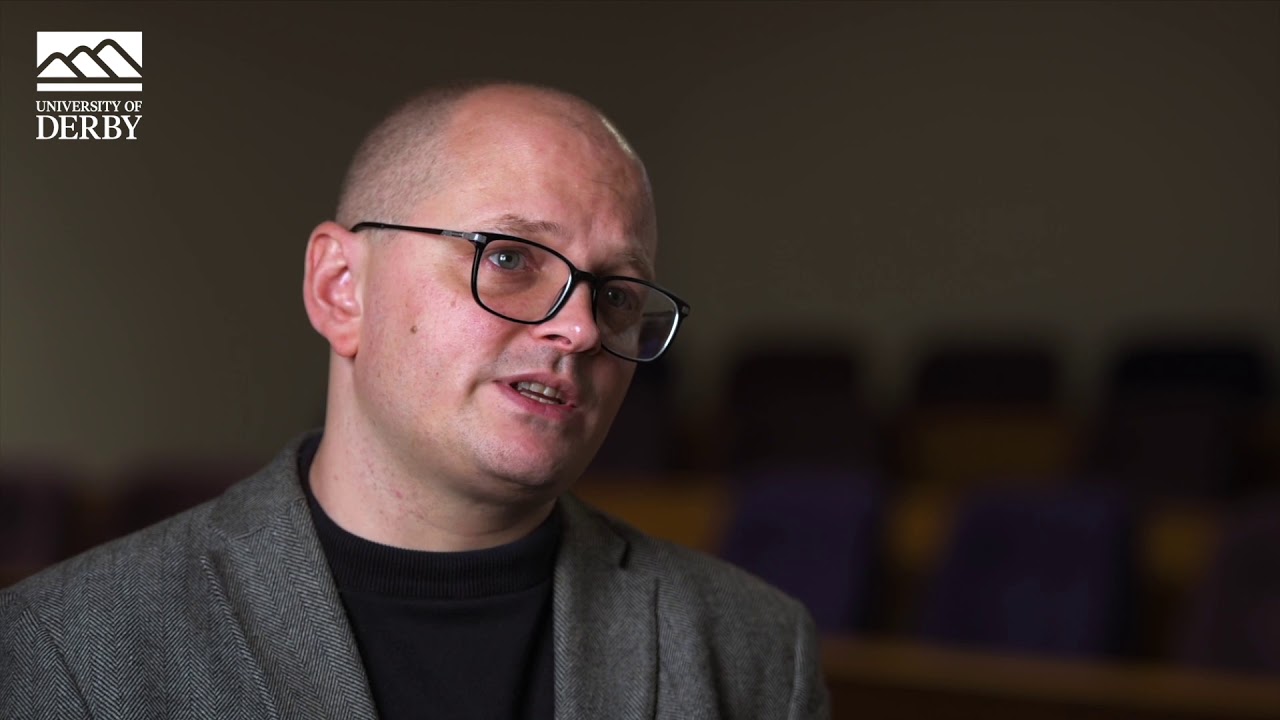
In the below video, Senior Lecturer, Dr Paul Whickman, answers some of the most frequently asked questions about English at the University of Derby.
English at Derby is an exciting, diverse and challenging course that not only incorporates the close analysis of literature, but also considers the situations in which literature is produced and read. This means your studies will include the intellectual and cultural history of art, film, philosophy, linguistics and sociology, as well as contemporary cultural politics. You will be introduced to a range of cultural expression from across the globe and from diverse historical periods.
The range of options will gradually allow you to acquire a degree of specialisation in a particular area. They include many aspects of literature and literary criticism as well as topics in English language and linguistics which range from the globalisation of the English language to the role language plays in the construction of categories of race, gender, and social class.
Literature asks questions about who we are, why we are here, and the nature of the world in which we find ourselves, and the BA (Hons) English reflects the vibrancy, dynamism and profundity of the subject at large.
The course was perfect for me as it allowed me to engage in high level intellectual study that sets me apart from other applicants. It developed my research, reading, presentation and teaching skills.
Charlie Pidcock
English student
A career focused degree
We will provide you with the skills to engage critically with the world in which you live, as well as developing your understanding of cultural difference and of the capacity of language to produce unintended effects and meanings. Such awareness is hugely valuable to employers.
An English degree will open up a range of career options. However, we also recognise the importance of supporting you to develop the skills sought by employers to maximise your employability.
The innovative second-year conference module involves working in groups to research, write and present a paper at a public event; it also involves marketing the event, working on designing posters, websites and social media campaigns. This module is frequently described by students as a transformative experience.
You will regularly meet with your Personal Academic Tutor throughout your degree. In addition to offering academic guidance, your tutor will help you explore career aspirations and advise you on developing and articulating your transferable skills.
We offer the opportunity for applied study in several modules, which can give you experience of working with various cultural institutions. There is also a programme of employability workshops and talks.
Not just lectures and classrooms
In addition to the lectures and seminars, we offer study visits to cinemas, theatres, museums, galleries and heritage centres.
The university library gives you access to a huge range of physical and online resources. Its collections contain a number of key databases for the study of English, including the JStor collection of academic journals, Bloomsbury eBook collections and Early English Books Online.
Boost your employability with a placement year
Take an optional placement year to put your skills into practice in a real-world setting. We’ll support you in finding a placement and throughout your time in industry. It’s a great way to gain valuable experience for your CV, build contacts, and explore career options before you graduate.
Please note that our modules are subject to change - we review the content of our courses regularly, making changes where necessary to improve your experience and graduate prospects.
Big spaces for big ideas
Kedleston Road offers it all: study in our largest library, relax in the Union Social Space, train in real-world healthcare settings, and stay active in our state-of-the-art Sports Centre.
The best way to find out if studying at Derby is right for you is to experience an Open Day. Get a feel for the city and campus, tour our first-class facilities and see where you could be living.
You will learn through lectures, seminars and tutorials. You will be taught in interactive and varied ways, with plenty of opportunity for you to discuss and debate ideas, so your course stays stimulating and thought-provoking. You will be able to test your ideas, clarify points and develop arguments based on your reading of primary and secondary sources. This will help you develop excellent communication skills, something that employers really value. You’ll also have the opportunity to write, market and deliver a conference paper in the second year, building a broader range of skills.
Real-world learning
On the Research in Practice module you will work as a consultant on a project co-designed with partners in the cultural and heritage industries, and thus understand how the skills you develop as an English student can transfer to a range of careers and benefit the community at large.
At third-year level you can negotiate your own project with a relevant graduate employer on the module Advanced Research in Practice, and there is, too, the opportunity to undertake a year-long placement as part of the course.
Assessment
The way we assess will enable you to build a broader range of skills than is traditional in English. We place emphasis on developing your ability to participate in debate and lead seminar discussions, as well as to work with others. These are key skills valued by employers.
There are no exams and forms of assessment include seminar debates, group presentations and conference papers alongside essays and longer research projects.
Developing as an independent researcher
Developing you as an independent researcher is key to the English degree. You will undertake research projects on several modules culminating in either the English Independent Study or Advanced Research in Practice in the final year. These are supported by the critical theory modules at stages 1 and 2 which equip you with sophisticated approaches to the analysis of literature, language and culture.
Supporting you all the way
We pride ourselves on being approachable and supportive. You'll have a personal tutor to help and advise you throughout your degree, providing an exceptional level of support.
The teaching team
You will be taught by experts who have published in a range of fields including eighteenth-, nineteenth- and twentieth-century literature, Romanticism, postmodernism, critical and cultural theory and linguistics. Several English staff form part of the Enlightenment and Romanticism research cluster, which has worked with various local and national organisations.
English staff: Dr Robin Sims (programme leader), Dr Anna Burton, Dr Amanda Blake Davis, Dr Shelby Judge, Dr Paul Whickman, Dr Cara Penry Williams.
Dr Robin Sims is a Senior Lecturer in English and is the Programme Leader of BA (Hons) English, as well as of several Joint Honours combinations. He is a Fellow of the Higher Education Academy and his areas of expertise include critical and cultural theory, postmodernism and literature of the fantastic. As well as producing articles and reviews in these areas, he has (with Dr Ruth Larsen and Professor Ian Whitehead) published on our undergraduate Conference module as an example of innovative assessment. His next project involves the myth of the ‘green man’.
Dr Paul Whickman is a Senior Lecturer in English and the Programme Leader of the MA in English. He is a Fellow of the Higher Education Academy as well as of the English Association, a member of the British Association for Romantic Studies and a Trustee of the Wordsworth Conference Foundation. His first book, Blasphemy and Politics in Romantic Literature: Creativity in the Writing of Percy Bysshe Shelley, was published in 2020, and in addition he has published various articles and book chapters on Romanticism, blasphemy and censorship. He is currently working on two book proposals.
Dr Cara Penry Williams is is a Senior Lecturer in English Language with extensive teaching experience and research expertise focussed on sociolinguistics and discourse analysis. She has published books and journal articles on intercultural communication, language and identity, and Australian English, amongst other topics. Some of her recent publications have used methods from linguistics to understand accounts of violence and discourse about family violence.
Dr Anna Burton is a Lecturer in English and a Fellow of the Higher Education Academy. She is also a member of the Association for the Study of Literature and Environment, the British Society for Literature and Science and the British Association for Romantic Studies. Her first book, Trees in Nineteenth-Century English Fiction: The Silvicultural Novel, was published in 2021. Currently she is working on a project concerning literary and cultural representations of trees, tree-planting, and arboreal caretaking in the English Lake District, and co-leads the 'Romantic Trees: The Literary Arboretum, 1740-1840' project.
Dr Amanda Blake Davis is a Lecturer in English Literature. Her research focuses on eighteenth and nineteenth-century literature and culture, with particular emphasis on Romantic poetry; Dr Davis is currently preparing her first monograph, Shelley and Androgyny, alongside a project provisionally entitled Shelley's Trees: Intermedial Ecologies. She is also co-editor of two forthcoming collections, Romantic Trees: The Literary Arboretum (Liverpool University Press) and Percy Bysshe Shelley in Collaboration: Influence and Intertextuality (Legenda).
Cara is a Senior Lecturer in English Language. As well as teaching undergraduate students on English Language modules, Cara researches topics in sociolinguistics and discourse analysis with a focus on Australian English.
Shelby is a Lecturer in Creative and Cultural Industries. She researches digital feminist and popular feminist responses to Incels and the manosphere, as well as contemporary feminist adaptations of Greek myth.
Amanda Blake Davis is a Lecturer in English Literature. Amanda specialises in eighteenth and nineteenth-century literature and culture with an emphasis on Romantic poetry, particularly Percy Bysshe Shelley. She has wider research inter...
You will be equipped with the skills and knowledge you need to give you excellent career prospects when you graduate. There are exciting opportunities in fields such as teaching, publishing, journalism, librarianship and arts administration, as well as roles in art galleries, media centres and museums.
Getting you career ready
Your degree is only part of your story.
We're here to help prepare you for life after university.
These are the typical qualification requirements for September 2026 entry.
Requirement
What we're looking for
UCAS points
112
A Level
BBC (At least a grade C in English or related subject (or equivalent qualification))
T Level
Merit
BTEC
DMM
GCSE
GCSE Maths and English Grade 4/Grade C (or above) or equivalent qualification
Access to HE
Pass Access to HE Diploma with 60 credits: 45 at Level 3 with a minimum of Distinction: 15, Merit: 24, Pass: 6. Must include passes in compulsory Level 3 subjects
English language requirements
IELTS: 6.0 (with at least 5.5 in each skills area)
These are the typical qualification requirements for September 2027 entry.
Requirement
What we're looking for
UCAS points
112
A Level
BBC (At least a grade C in English or related subject (or equivalent qualification))
T Level
Merit
BTEC
DMM
GCSE
GCSE Maths and English Grade 4/Grade C (or above) or equivalent qualification
Access to HE
Pass Access to HE Diploma with 60 credits: 45 at Level 3 with a minimum of Distinction: 15, Merit: 24, Pass: 6. Must include passes in compulsory Level 3 subjects
English language requirements
IELTS: 6.0 (with at least 5.5 in each skills area)
If you are in Year 13 and applying for a full-time undergraduate course (including our joint honours courses), we recommend that you apply through UCAS.
Like most universities, we operate extended teaching hours at the University of Derby, so contact time with your lecturers and tutors could be anytime between 9am and 9pm. Your timetable will usually be available on the website 24 hours after enrolment on to your course.
Course updates
The information provided on this page is correct at the time of publication but course content, costs and other individual course details do change from time to time and are updated as often as possible, so please do check these pages again when making your final decision to apply for a course. Any updated course details will also be confirmed to you at application, enrolment and in your offer letter.
If you are thinking about transferring onto this course (into the second year for example), you should contact the programme leader for the relevant course information as modules may vary from those shown on this page.
.jpg)



-(1)-(1).jpg)


.jpg)


.jpg)
.jpg)
/prod01/derbyacuk/media/derbyacuk/assets/organisation/services/centre-for-excellence-in-learning-and-teaching/Animation-5098-0131-(1).jpg)
/prod01/derbyacuk/media/derbyacuk/assets/study/support/module-evaluation-questionnaire-promo.jpg)
/prod01/derbyacuk/media/derbyacuk/assets/study/postgraduate/Why-Choose-Derby-PG-Tutor-01---2000-x-1333-1066x1333.jpg)
/prod01/derbyacuk/media/derbyacuk/assets/study/employability/Image---employability.jpg)