New courses now available in Chesterfield

View coursesView courses

£500 off selected accommodation

Explore HallsExplore Halls
 Undergraduate Course 

BSc (Hons)

Zoology with Foundation Year

 Accredited by the Royal Society of Biology 

Why study Zoology at Derby?

  • Fieldwork opportunities in the UK and overseas - the costs of mandatory trips are included in your course fee
  • Facilities include an Aquatic Research Facility, glasshouse, insectary, and specialist laboratories
  • Tailor to your career ambitions through a range of modules
  • Learn from research-active lecturers - current research includes coral reef conservation, the evolution of primate behaviour, and climate change
  • The content of this course is aligned to the priorities of global initiatives, like the United Nations Sustainable Development Goals
  • This course was one of the first of its kind in the country to receive accreditation from the Royal Society of Biology - we also have accredited degree pathway status from the Chartered Institute of Ecology and Environmental Management
  • Gain practical experience through placements and internships with our partner organisations. This course can be studied with or without an Industrial Placement Year

This hands-on course, including fieldwork and placement opportunities, will give you the intellectual and practical skills needed to understand the complexities of the animal kingdom, such as behaviour, ecology, conservation and genetics. 

3rdfor assessment and feedbackBSc (Hons) Zoology - National Student Survey 2025
Top5for student voiceBSc (Hons) Zoology - National Student Survey 2025
Top10for teachingBSc (Hons) Zoology - National Student Survey 2025

We're recognised for what we do.

View more rankings

Zoology rankings

  • Top 10 for learning opportunities - BSc (Hons) Zoology, National Student Survey 2025
  • Top 10 for learning resources - BSc (Hons) Zoology, National Student Survey 2025
  • Top 25 for Zoology in the UK - The Guardian University Guide 2026
  • 3rd for satisfaction with teaching - The Guardian University Guide 2026

Biology and Zoology - your questions answered

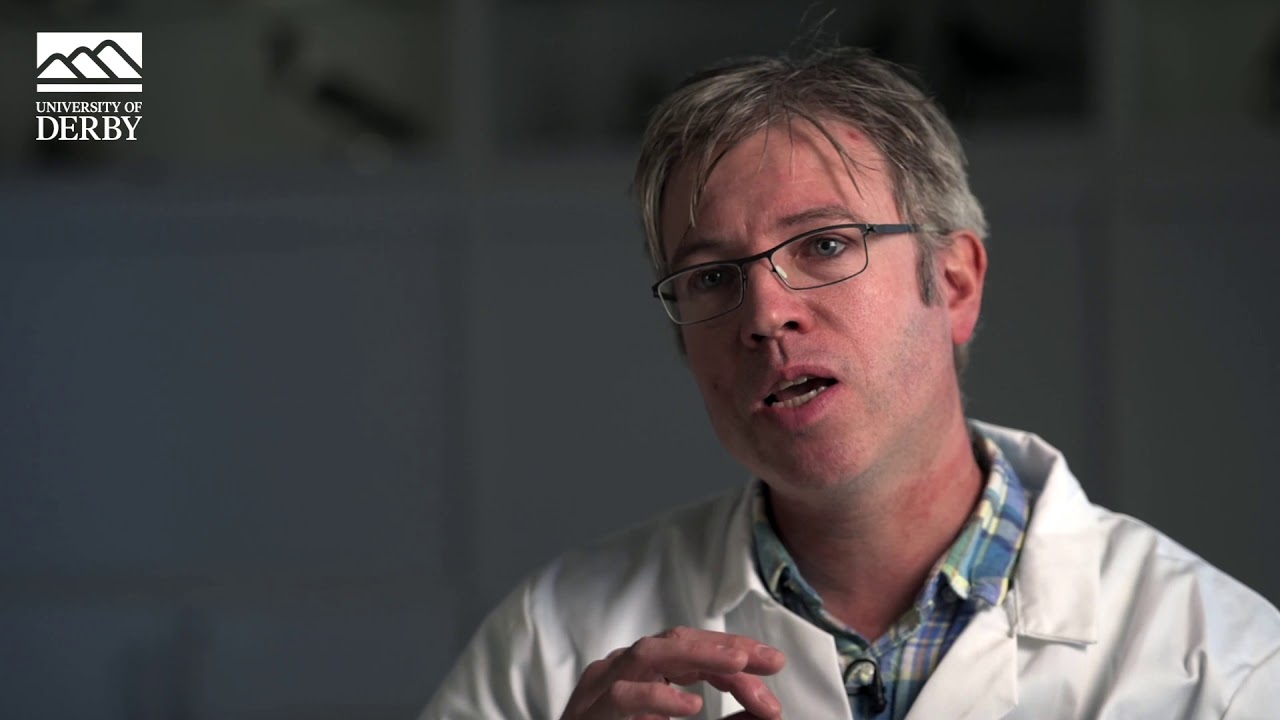
Programme Leader for Biology Dr David Elliott answers your frequently asked questions about Biology and Zoology.

Dr David Elliot, Programme Leader in Biology.

View Biology and Zoology - your questions answered! video transcript

Biology and Zoology - your questions answered! video transcript

The University of Derby's main site, Kedleston Road, viewed from the air.

The front entrance to the building.

Dr David Elliott, Programme Leader in Biology, in his lab.

My name is David Elliott. I'm an Associate Professor at the University of Derby. I also lead the Biology programme and I teach on the Zoology programme as well.

(We see a palm tree, a taxidermy fox, animal skull and a skeleton in glass-fronted cabinets in the Biology department corridor)

We have a BSc (Hons) in Biology and a BSc (Hons) in Zoology. Both of those courses can have an option of placement year as well where the student would work in industry for a year.

Who is this degree for?

(An aquarium within the Aquatic Research Facility at the University)

Students should study Biology and Zoology at Derby if they want to find solutions to the problems in the world and advance their own knowledge. But not only that but especially if they want to advance human knowledge.

(Microscopes in a lab)

Studying a science degree is about discovery. Whether it's discovering things that new for science or discovering things that are new for yourself and your interpretation of the world. We've had the industrial revolution, we've had technical revolution within information technology. We're now going through a bio-based revolution if you like.

(Rocks and precious stones in the Geology department, potted cacti)

There's this emergent thing called the bio economy whereby the solutions that used to be solved with oil and gas and chemicals, they are now being solved with biology.
So if you wanna be a part of that then that's a great reason to study these subjects.

If your love is chemistry, or your love is physics, you can take that and bring that in a unique way to biology. And you can be a biologist who's a physicist as well.
And so to me biology is the one science and zoology, the biological sciences they encompass all the other sciences. They're more complex and they require a knowledge and an understanding and an appreciation of all the sciences.

What skills will students develop and how will they learn?

Students learn through a variety of different ways at Derby. This includes your formal lectures, tutorials, discussions, etc. But a really important part of the learning that we do is in practice, you know practice-based learning. We do require all of our students to undergo 30 hours of work-based learning as part of that course. We help students in that way. We also expect them to have some independence in gaining those experiences.

What opportunities are there for students?

There's opportunities to get involved in the research of the staff, there's opportunities to get involved in the student societies. There's opportunities to get paid internship work with us here at Derby, there's opportunities to go volunteering and there's opportunity to do external things as well.

What facilities are available to students?

Students have access to a wide range of specialist equipments at the University of Derby. Whether that's the Aquatic Research Facility, the molecular biology labs, the field equipment, the microbiology lab, the insectary, the greenhouse. We have a lot of different facilities.

Who will students be taught by?

Students of Biology and Zoology at Derby will be taught by staff with a wide range of expertise. We also bring in experts from outside the university to make sure that what we're offering is relevant to the real world and the jobs that the student wants to do.

Zoology at Derby

Despite global efforts from government officials and policy makers to promote coexistence between humanity and our ecosystems, human progress is disturbing the natural balance of our environment. This is a decisive moment in our history, requiring leaders who are bold and innovative in their approach if we are to restore and protect for future generations.

If you are passionate about protecting endangered species, safeguarding habitats and enhancing the knowledge and understanding of animals in the wild and in captivity, this course is for you. Our focus is on equipping you with strong intellectual, technical, research and personal skills to build an impressive CV and meet the needs of employers. We have mapped the content of our courses to the priorities of global initiatives, like the United Nations Sustainable Development Goals, to ensure you graduate with the scientific skills and knowledge needed to transform the issues of today.

Focusing on animal biology, our zoology course covers a broad range of topics such as wildlife conservation, ecology and animal behaviour. You’ll also cover the sciences that underpin zoology including genetics, biochemistry and statistics. Zoology is a practical subject, so you will learn in the laboratory, field and classroom. Whatever you are studying, we will encourage you to link with employers, from short-term work experience to a full year in industry.

You’ll join a community of staff and students who are dedicated to applying their passion, knowledge and skills to help safeguard the survival of Earth’s natural environments and animal populations. In the below video, some of our Zoology and Biology students tell us about the moments that inspired them to study the course.

Biology and Zoology students from the University of Derby speak about their experiences on their course so far.

View What inspired me to study Zoology/​Biology video transcript

Expert teaching

As a Zoology student at the University of Derby you'll be working with lecturers and tutors who have a wealth of knowledge and experience, and are carrying out research designed to offer fresh perspectives on important issues. Their wide-ranging work includes research into:

Dr Michael Sweet, Associate Professor in Aquatic Biology, is just one of the lecturers you will work with during your studies. Before coming to Derby he travelled the world working on a variety of projects including biodiversity index surveys in the Philippines and Malaysia, radio tracking Sumatran rhinos in Borneo, and being a game ranger in mainland Africa and Madagascar.

Michael is now the manager of our Aquatic Research Facility and teaches on several of our undergraduate modules. He has won the prestigious Times Higher Education award in 'Outstanding Research Supervisor of the Year - 2025'. This nomination recognises his commitment to mentoring the next generation of marine scientists, leading to global impact. He is also involved in a major world-leading research project looking at diseases that affect coral reefs.

Also Dr Joana Carvalho, Dr Alessia Bani and a PhD student are working with Twycross Zoo and have pioneered a groundbreaking method that could play a crucial role in safeguarding chimpanzees from escalating threats and the risk of extinction. The project aims to assess the conservation status of wild chimpanzees by using a range of traditional and emerging methods including, believed to be for the first time, the use of eDNA from air and soil samples to detect the number of West African chimpanzees in Guinea-Bissau 

Explore our specialist facilities

Gain practical, hands-on experience in our real world learning facilities. You will develop new skills and knowledge in your subject, supported by our expert teaching team.
  • Aquatic Research Facility
    Offers our students a unique opportunity to participate in high level research and work with some of the world leaders in the field of aquarium and zoo research.
  • Bioscience Superlab
    Our state-of-the-art Bioscience Superlab and Research Lab transforms learning and research for students, staff, and researchers offering real-world, sector-relevant practical experience.
  • Glasshouse
    Our glasshouse is used for keeping plants from a diverse range of habitats from deserts to tropics.
  • Insectary
    Our insectary houses many different species of insects for you to examine and learn about. It is also used by our Forensic Science students to investigate how they can assist in a forensic investigation.
Fish swimming around the corals in the Maldives

How we're helping corals survive

Coral reefs are dying off at an alarming rate. Our Aquatic Research Facility is carrying out work with organisations across the globe to make corals more resilient in the face of man-made afflictions.

Find out more about our coral reef researchFind out more about our coral reef research
A render image of the Superlab

New Bioscience Superlab

Opened in 2025, our state-of-the-art Bioscience Superlab and Research Lab transforms learning and research for students, staff and researchers. These facilities house cutting-edge technology and offer real-world, sector-relevant practical experiences.

Find out more about the Superlab and Research LabFind out more about the Superlab and Research Lab

Excellent fieldwork opportunities

Fieldwork is a vital element of this course and so every stage your studies will be enriched with fieldwork opportunities - the cost of mandatory fieldwork is included in your course fee. Through our fieldwork programme, we introduce students to a variety of survey techniques for a wide range of species, such as:

You’ll also have access to Cuckoos Tor, a site on the edge of the Peak District National Park and owned by the University of Derby that is dedicated to long-term research and ecological experiments. Current projects include restoration ecology, natural flood risk management, community engagement with biodiversity, and sustainable land management - and you’ll be able to get involved.

For further practical experience, you'll have plenty of opportunity to apply for work placements and paid internships. All of this means you'll be well placed to launch your career, whether you are looking for a graduate job or are planning to go into further study or research.

Take a look at the below video created by our second year BSc (Hons) Zoology students during a one-week trip to Mallorca as part of their optional module in ‘Field Biology’. Surrounded by stunning landscapes, they went on short excursions around the island, explored the natural plant diversity, searched for invertebrates, went on scenic hikes and located wild goats.

Professional credibility

This course was one of the first of its kind in the country to receive accreditation from the Royal Society of Biology, an accolade which carries significant weight within the sector and is only granted after a rigorous independent assessment. The Royal Society acts as a single unified voice for biology, advising the government, influencing policy, advancing education and professional development, and encouraging public interest in the life sciences. It only accredits degrees that offer students a solid academic foundation in subject knowledge, technical abilities and transferable skills.

This means that, when you graduate, you’ll meet the requirements for Associate Membership of the Society (AMSB).  Following appropriate professional experience, you can then apply for full membership, which is widely recognised throughout the industry and by potential employers.

In addition, we also have accredited degree pathway status from the Chartered Institute of Ecology and Environmental Management (CIEEM). After being assessed, CIEEM approved that this course offers students the underpinning knowledge and practical skills, including core ecological and environmental theory and significant practical experience, which are required by employers seeking to recruit graduates for a wide range of applied practitioner roles.

A close up of a butterfly in a microscope plate

Strong employer links

You’ll benefit from excellent opportunities for work experience and internships through our partnerships with organisations like Sea Life, Derby Museums and the Derbyshire Wildlife Trust. We encourage you to undertake work experience throughout your degree to gain real insights into zoology and related areas.

You could also get involved in voluntary work with zoology related industries and the wider community, contributing to initiatives which help safeguard local nature sites and improve the region's green spaces. 

We are currently working with Derbyshire Wildlife Trust and Derby City Council on rewilding Allestree Park. This is the UK’s largest rewilding space which has involved a community consultation to find out what local people want. Some of our students are already working on independent studies projects in the park, with one test-driving the citizen science protocols for monitoring the changes in the park as the rewilding continues.

We have also just won two associate Knowledge Transfer Partnership with Derbyshire Wildlife Trust, lasting two years, to predict the trajectory of rewilding ecosystems. This will enable you to learn about the remote sensing and modelling we use for this. It will also enable staff to further stretch their research impact in a complex and growing subject area, as well as providing the chance to apply cutting edge, technical research to commercial activities. 

We have also been working for several years with Down to Earth Derby, on nature-based regeneration and connecting communities with nature and growing food. A major project we are working on at the moment, with the Eden Project, is a community garden on part of Sturgess Fields, a site owned by the University between Kedleston Road and Markeaton Street sites. The plan is to create a New Commons that will be managed with the community. There are lots of opportunities for you to work on here, both in creating and maintaining the site, undertaking ecological monitoring and getting involved in community education programmes.

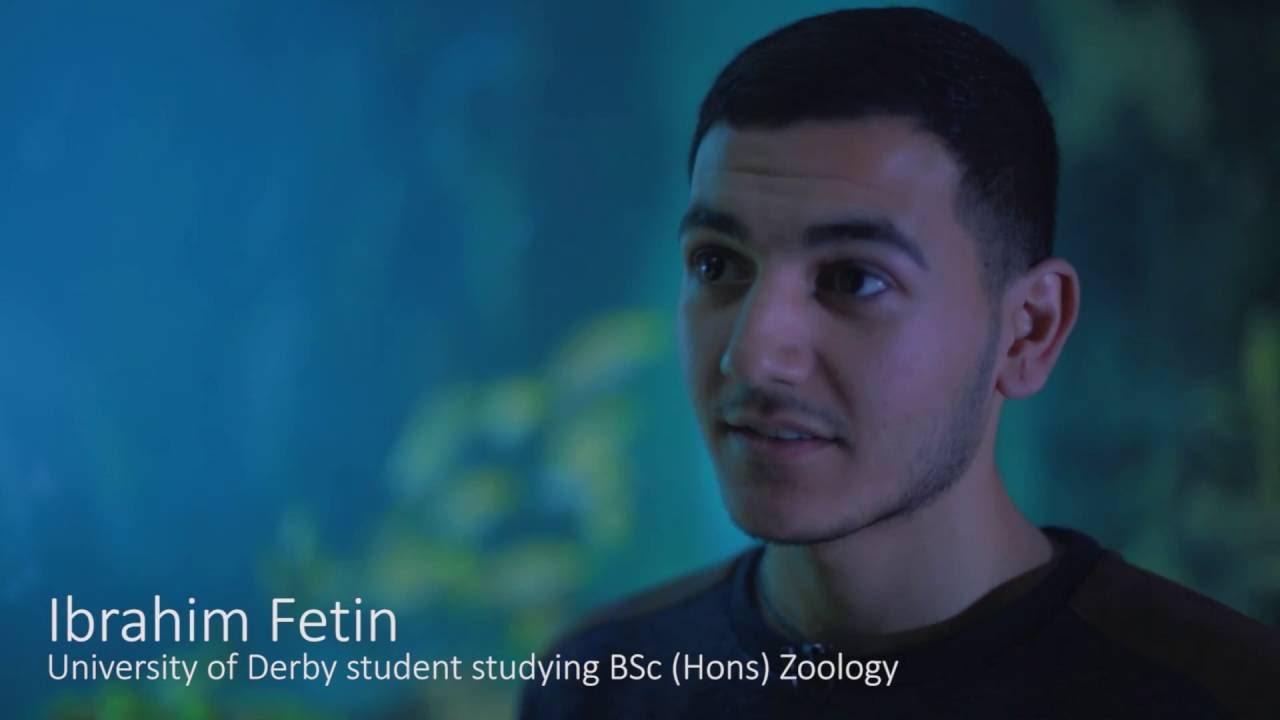
Take a look at the below video for graduate, Ibrahim Fetin's experience at Sea Life where he carried out his third year research project on on black tip reef sharks.

Sea Life project

Ibrahim Fetin carried out his third-year research project on blacktip reef sharks at Sea Life.

A new partnership between the University of Derby and the National Sea Life Centre. James Robson, Curator at the Sea Life Centre illustrates why such a partnership is important for both institutes

View Sea Life Centre Partnership video transcript

Sea Life Centre Partnership video transcript

Ibrahim Fetin:

My name is Ibrahim Fetin and I’m from the University of Derby and I'm 21 years old. I'm doing the degree in Zoology at the moment. I'm a third year and at the moment I'm doing my IS project which is involved with the University of Derby and I'm doing it at sea life in Birmingham.

I'm looking at the stress levels of black tip reef sharks in accordance to the abundance of people and the noise levels within the enclosure. It basically involves husbandry techniques feeding of the Sharks obviously the food preparation as well but my actual project was to come into the enclosure into the tunnel and actually identify each individual shark. I would use their dorsal fin and a black tip on their dorsal fin is basically the identification point so it's basic like a fingerprint for humans so it's unique to every individual because I use the technique called Image Jay and Image Jay what it does is it has the colourations of the black tip on the dorsal fin of the shark and it just shows you every unique pattern.

Documentation techniques basically involved observational techniques so I would come in for example nine o'clock in the morning and I would identify the sharks using the black tips and I'd do a continuous observation so I'll start with five minute intervals and I'll actually record the sharks and their behaviour and just record any abnormalities. At the moment there is 14 black tip reef sharks in the enclosure which is the biggest amount of most amount in Europe and currently three are pregnant with one of them being due next month and this is really really important, not only in terms of conservation but in terms of having sharks breeding and providing offspring which then can be transferred to different enclosures which is increase the abundance of the amount obviously in the wildlife if reintroduction of techniques are used as well.

It's important to identify the shark within the enclosure just just in case if a minor mishap happens they can straight away identify the shark and get to the root of the problem. It's also good for conservation reasons as in obviously another key was identification factor they can go out in a while and actually identify the individuals and see how their behaviour changes with different independent factors so whether it's fishing because they're not they're not in a sense commercially big in a sense of fishery but they are actually caught when the fisherman - hunting father things so in that sense is really important to conserve the species as well.

James Robson:

My name is James Robson. I'm the curator here at the National Sea Life Centre of Birmingham. So my role here is curator as I'm looking after the whole collection so that's all the animals within the group and we've got a really nice diverse collection in this aquarium which makes it really really helpful for things like when we're doing research because we can offer a real wide range of taxa to work on. A lot of the work we do is actually behind the scenes and this is part of a behind the scenes area so we call this the quarantine area and the way this really operates is any new animals that come into the collection so if we've been sent from another sub group from from Europe or somewhere else we'll come here first we'll observe them.

We'll make sure they're feeling well we'll make sure they've got no parasites, any diseases before they go out on to display. Another operation for this area is this is where we would conduct any research work we want to do so so we want to do a feeding trial to see how they respond to different types of food. We'd much rather do it behind the scenes were a bit more controlled, it's a bit nicer for the animals and it's not on display so this is essentially where we'll do any treatments, any husbandry but we'll also do our research work.

So we've got to be of a cornucopia going on in here at the moment it's a real wide group of animals so right now we've got some animals that are going to go on to display in the next couple of weeks and it's just a mix of reef fish a small reef fish we've been rearing them on so we've got them in as a sort of juvenile larvae stage we've been rearing them on there now got to a size where we can put them on display and share them out and put them on a certain display tanks up in the coral caves.

We've also got just towards the back we've got some corals live corals and an anemone that's going to be going into our new soft coral display that's that's again up in the coral cave area and then over my shoulder behind me we've got some freshwater rays that is part of the reason we've split them up is they're breeding at the moment so once the female is pregnant the best thing to do is take the male away because what the male to do is just keep bothering the female so we take the male off show and we essentially rest the female give her a break, allows her to basically produce the young. Once she's produced the young then we can reintroduce the male if you want to breed them again and then on my left we've got a series of more tanks and that's a mixture of native species.

We've got blue spot ribbon tails which are a tropical stingray and it's part of a very important study group so we've had them for about six month now and we've got a mixture of five females to one male and that allows us to make sure that whichever pups we get from that particular female is definitely only from one male and that's really important for managing genetics so when the pups are born when the babies are born their little tiny rays we're going to chip them so we know exactly which one is which and then when we send them out into Europe we can track their life for the hopefully generations to come.

So they just here now we're just just resting them again at the moment because they're ready to pup. We've been ultrasounding the females so we know that of the females we've got four pregnant females which have produced about 12 pups so 12 juvenile stingrays.

Dr Michael Sweet:

My name is Dr Michael Sweet I'm a university lecturer at Derby. I work mainly on invertebrates but we look into all aspects of diseases and climate change and we're now branching more into the aquarium and that section as well. So we're really excited about this extra part of the collaboration with Sea Life and we've designed a whole room, quite a large room really almost the size of this to turn into aquarium research facility where we can concentrate exactly on a specific longer-term projects for our students, for undergrads, masters all the way up to PhD students.

So we have started doing a lot more behavioural studies now and that's particularly with the interest from the students they seem to be really really keen on behavioural studies and obviously of the larger animals as well so that's the things like the Otters, the Penguins and the Sharks and so we do facilitate quite a lot of that study and most of that is actually going to be done on-site here at Birmingham itself.

As far as the work we can do in the university we're going to look at the smaller scale thing so for example the development of the different sharks and rays. We can bring them in when they're in their little egg cases we can monitor development and see about hatching rates and under different scenarios as well using real-time climate change scenarios to see how that's going to affect development stages of these animals in the future.

Their benefit to Sea Life specifically is obviously because our information comes from two ways so quite a lot of the work comes directly from questions raised by Sea Life staff and particularly, James of the curator two questions which save I have pondered on for a while or they've just recently seen and they want to know an answer to you and that's where obviously we come into it and we can design projects we can look into the amount of replication needed and we can actually implement that with quite a strong well-educated labour force, ie our students.

Far-reaching research

You'll learn from a research-active teaching team who are pursuing important studies into diverse topics including the evolution of animal mating strategies, disease-causing agents in corals, bioremediation of freshwater ecosystems, the welfare of captive orangutans, and the genetics and conservation of natterjack toads.

Boost your employability with a placement year

Take an optional placement year to put your skills into practice in a real-world setting. We will support you in finding a placement and throughout your time in industry. It’s a great way to gain valuable experience for your CV, build contacts, and explore career options before you graduate.

What you will study

Please note that our modules are subject to change - we review the content of our courses regularly, making changes where necessary to improve your experience and graduate prospects.

Kedleston Road, Derby Campus

Big spaces for big ideas

Kedleston Road offers it all: study in our largest library, relax in the Union Social Space, train in real-world healthcare settings, and stay active in our state-of-the-art Sports Centre.

Kedleston Road, Derby Campus entrance

Undergraduate Open Days

The best way to find out if studying at Derby is right for you is to experience an Open Day. Get a feel for the city and campus, tour our first-class facilities and see where you could be living.

Book your Undergraduate Open DayBook your Undergraduate Open Day

How you will learn

You’ll be taught through lectures and tutorials, supported by hands-on practicals and fieldwork. You could study rutting red deer, or spend a week completing a project in the Mediterranean. You’ll also conduct an independent research project to develop your analytical skills in an area of your choice.

Assessment

Assessment is varied and includes computer-based assessments, scientific posters and oral presentations, professional reports, essays, making short videos, fieldwork and laboratory reports, as well as traditional written examinations. Many assessments can be tailored to suit your own interests and career goals.

Work placements

We offer full support to you if you decide to do a work placement in year three, which we strongly recommend. Work placement allows you to apply in a working environment the skills and knowledge you have gained on your course. This will give you more desirability in the eyes of potential employers. There is also a vocational module so you can gain credits by doing work related to your degree.

an iceberg

Nature Based Solutions Research Centre

Specialising in securing clean environments, nature recovery, and resilience to natural hazards, we work collaboratively to safeguard our planet for future generations.

Learn more about our research Learn more about our research
Person offering support to a student Person offering support to a student with a laptop Student smiling with tutor Tutor smiling with student and laptop

Helping you reach your full potential

Our Personal Academic Tutoring programme supports your academic journey, helping you achieve your goals and unlock your potential.

Explore the programme

Personal Academic Tutoring

At the University of Derby, every student is assigned a Personal Academic Tutor (PAT) from the very start of their degree journey. This dedicated tutor becomes a key figure in your academic life, offering guidance, support, and insight to help you make the most of your university experience. Whether it's through one-to-one meetings or more informal catch-ups, your PAT will work with you to explore your strengths, address any challenges, and help you achieve your full potential. This relationship is designed to ensure you're not just succeeding academically, but also growing as an individual, developing the skills and confidence you'll need for your future career.

Your PAT will provide tailored advice to support your academic journey, whether that's by discussing your work, helping you set goals, or exploring career options. These regular meetings give you the space to reflect on your progress, understand where improvements can be made, and build on your strengths. At Derby, we want you to feel both challenged and supported. Your PAT will encourage you to push your boundaries, think critically about your work, and develop a proactive approach to your studies.

But it's not just about coursework. Your PAT will also help you identify extra-curricular opportunities, whether that's joining clubs, gaining work experience, or developing new skills outside of your course. These experiences not only enhance your CV but also give you the confidence to tackle future challenges. In short, your Personal Academic Tutor will be there to guide you every step of the way, ensuring you leave university with more than just a degree — but with a wealth of experiences, skills, and the knowledge that you're ready for the next chapter of your life.

Building Strong Industry Connections

We believe that real-world experience is an essential part of academic success. Our partnerships with leading organisations across various sectors ensure our students gain valuable insights, hands-on opportunities, and access to the latest industry innovations.

Through collaboration with our industry partners, we bridge the gap between classroom learning and professional practice, preparing our graduates to thrive in competitive global markets.

Careers

"Completing a research placement at Birmingham's National Sea Life Centre was an incredibly strong and positive addition to my studies at the University of Derby. It really helped develop my CV, enhanced my PhD applications and gave me a head start in my career pathway." Ben Mcilwaine, BSc (Hons) Zoology graduate

Our focus is on ensuring you develop strong intellectual, technical and personal skills to build an impressive CV and meet the needs of employers. With opportunities for internships, volunteering and placements, our hands-on approach to study will ensure you’re ready for the world of work.

Recent graduates have gone on to work in areas such as:

Through our Professional Development Package, you'll gain valuable skills, including:

In addition, our zoology course provides an excellent preparation if you would like to move on to further study, including medical qualifications, a masters degree or a PhD.

Getting you career ready

Your degree is only part of your story.

We're here to help prepare you for life after university.

Career Support Image

94%
of UK graduates are in employment or further study.

2nd
for employability.
Uni Compare Annual Student Review Rankings 2026.

87%
of UK graduates say their current activity is meaningful.

Getting you career ready

Your degree is only part of your story. We're here to help prepare you for life after university. We'll tailor your talents and help you build the tools that will set you apart when you are ready to look for your first graduate role.

Our staff have valuable and varied experiences in the workplace and beyond. And we have great links to industry. This means you'll have opportunities to apply your learning. You'll find work experience that's directly relevant to your studies, including placements and real projects set by businesses.

Our promise

We promise to provide an inclusive approach; supporting, advising and guiding you on your employability journey to success. We will listen to your needs and signpost opportunities for you to engage with up to three years after graduation.

Find out more about our Careers and Employability services

Entry requirements

Contextual offers may apply to students who meet certain criteria.

Contextual admissions

At the University of Derby, we aim to attract the very best students to join us and to support their progression to university to ensure they reach their full potential and achieve their ambitions. We believe the very best students come from all backgrounds and we want to build a community that reflects our society.

What is a contextual offer?

Contextual offers are used by universities and colleges to take account of a student’s individual circumstances. Employing contextual offers at the University Derby will allow our admissions team to identify applicants with the greatest potential to succeed in higher education and be an exceptional Derby student. This makes the application process fairer and builds confidence in students about their ability to be part of our academic community.

We will use the information in an application form and may either reduce grade requirements or give extra consideration when deciding whether to give a contextual offer. We will also support these students through information, advice and guidance, outreach activities and on-campus visits before and during the application process.

What is the criteria?

Typical criteria may include one or more of the following:

  • Students who are care experienced
  • Students who are estranged from their families
  • Students who are refugees or asylum seekers
  • Students whose parents/carers are in the UK armed forces

*Please note students need to declare they meet one of these criteria on their application.

Find out more about our admissions policies

2026/27
2027/28

These are the typical qualification requirements for September 2026 entry.

RequirementWhat we're looking for
UCAS points72
A LevelDDD
T LevelPass
BTECMMP
GCSEGCSE Maths and English are preferred, however if you don't have these qualifications you will be able to undertake Maths and English at Level 2 as part of your course of study
Access to HEPass Access to HE Diploma with 60 credits: 45 at Level 3 with a minimum of Distinction: 0, Merit: 30, Pass: 15
English language requirementsIELTS: 6.0 (with at least 5.5 in each skills area)

These are the typical qualification requirements for September 2027 entry.

RequirementWhat we're looking for
UCAS points72
A LevelDDD
T LevelPass
BTECMMP
GCSEGCSE Maths and English are preferred, however if you don't have these qualifications you will be able to undertake Maths and English at Level 2 as part of your course of study
Access to HEPass Access to HE Diploma with 60 credits: 45 at Level 3 with a minimum of Distinction: 0, Merit: 30, Pass: 15
English language requirementsIELTS: 6.0 (with at least 5.5 in each skills area)

Fees and funding

2026/27
2026/27Full-timePart-time
UK

£9,535 per year*

N/A

International

£15,500 per year*

N/A

*This is the fee for the Foundation Year. Subsequent UK fees are £9,535 per year. Subsequent International fees are £17,500 per year.

Further information about our fees and support you may be entitled to

Additional costs and optional extras

Additional costs and optional extras

We're committed to providing you with an outstanding learning experience. Our expert teaching, excellent facilities and great employability prepare you for your future career. As part of our commitment to you we aim to keep any additional study costs to a minimum. However, there are occasions where students may incur some additional costs.

Included in your fees
  • All equipment and consumables needed for your experimental/ fieldwork are provided by the University. Consumables for the Independent Study, subject to costing approval by your Programme Leader
  • Free membership of the Royal Society of Biology for a year after graduation
  • Residential fieldtrips in compulsory modules, previous destinations have included Tenerife and Majorca. Mandatory day fieldtrips in optional modules: previous destinations have included Kew Gardens, Sea Life Centre and the Peak District
  • Students studying the three year course will receive free membership of the Chartered Institute of Ecology and Environmental Management (CIEEM) during their studies until they graduate
Mandatory costs not included in your fees
  • If not already owned, appropriate footwear for fieldwork such as Wellington/Walking boots - approximate cost is between £10-£100
  • If not already owned, appropriate outdoor clothing such as a waterproof jacket and trousers - approximate cost is between £50-£100
Optional costs not included in your fees
  • Recommended textbooks - approximate cost is £60
  • Additional international fieldtrip costs for optional modules as follows: Tropical Marine Biology L6 (Maldives) - approximate cost is £3,000
  • Travel to work experience/placements - cost is dependent on your placement venue of choice

How to apply

UK students

If you are in Year 13 and applying for a full-time undergraduate course (including our joint honours courses), we recommend that you apply through UCAS.

International students

The quickest and easiest way to apply is through our online application portal.

If you'd like support with your application, you can contact one of our trusted local representatives.

If you're currently living in the UK and applying for a full-time undergraduate course, we recommend using UCAS.

Additional information about your studies

Teaching hours

Like most universities, we operate extended teaching hours at the University of Derby, so contact time with your lecturers and tutors could be anytime between 9am and 9pm. Your timetable will usually be available on the website 24 hours after enrolment on to your course.

Course updates

The information provided on this page is correct at the time of publication but course content, costs and other individual course details do change from time to time and are updated as often as possible, so please do check these pages again when making your final decision to apply for a course. Any updated course details will also be confirmed to you at application, enrolment and in your offer letter.

If you are thinking about transferring onto this course (into the second year for example), you should contact the programme leader for the relevant course information as modules may vary from those shown on this page.

Discover Uni

Full-time

Other courses you might like